
Sickleweed (Falcaria vulgaris), an aggressive Eurasian member of the Carrot Family, was discovered west of the Monroe Municipal Airport. Landowners, farmers, and road crews are urged to learn to recognize it — and to stop cutting it after seed has ripened.
MONROE, Wis. — On the morning of August 20, 2024, a Wisconsin ecologist who also happens to be a pilot was practicing touch-and-go landings at the Monroe Municipal Airport looked out the left window of his aircraft to clear the traffic pattern — and instead found a plant that had never been documented in the state.
That same day, that chance sighting became a case study in how new invasive plants arrive, how they are found, and how easily they can be missed. The Applied Ecological Institute (AEI), the Lower Sugar River Watershed Association, and the Renz Weed Science Lab at the University of Wisconsin–Madison are jointly alerting landowners, farmers, township road crews, and county land conservation staff to sickleweed (Falcaria vulgaris) — a deep-rooted Eurasian perennial that pushes through dense sod, tolerates herbicide drift and annual mowing, and appears to have colonized a Green County, WI road shoulder in windrows of mowed clippings.
The discovery: botany at 100 miles per hour
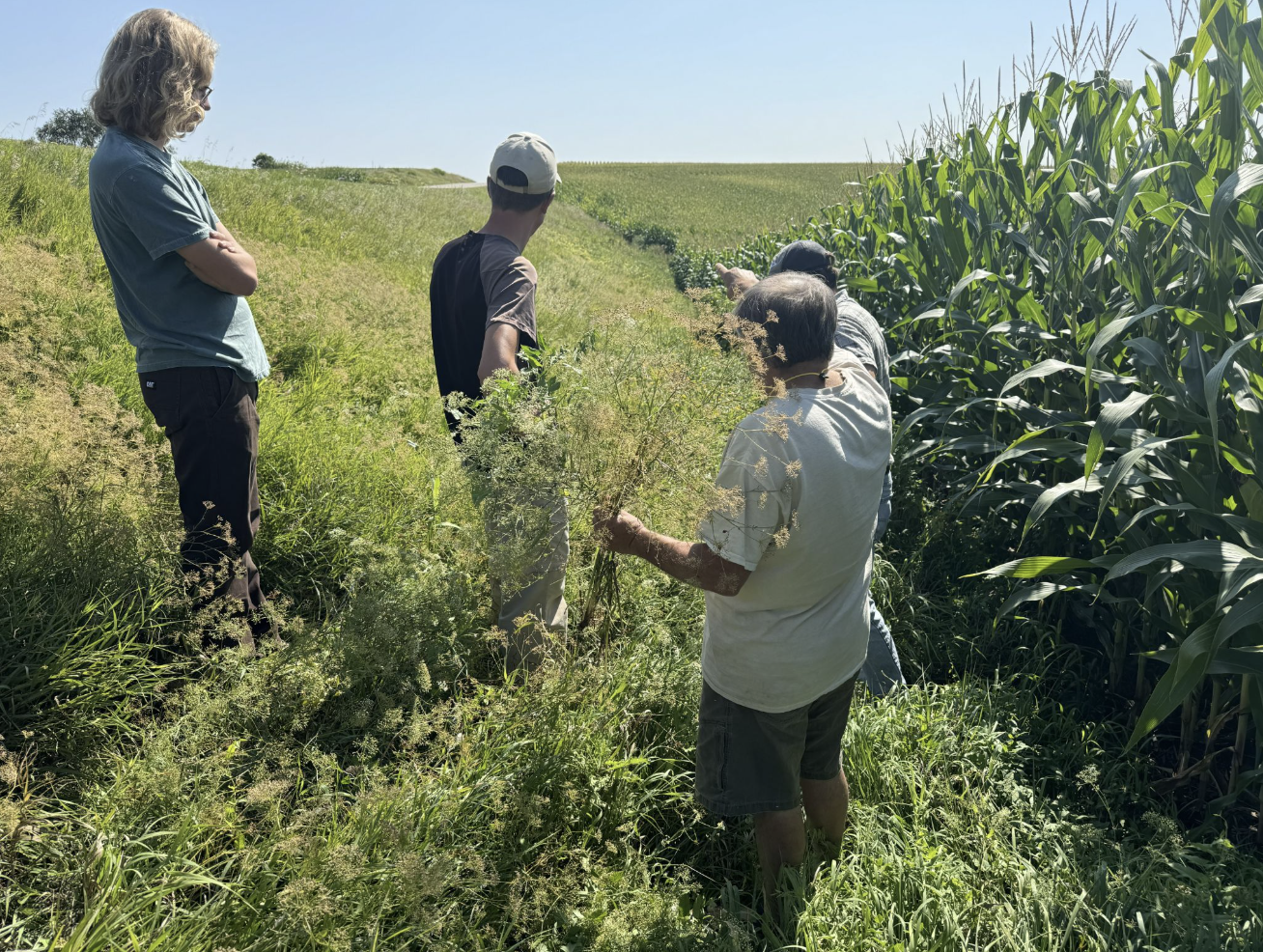
A dense, low colony of sickleweed lines the road margin and field edge west of Monroe Municipal Airport — the stand first seen with conspicuous white flowers from 400 feet during a flight training exercise now setting seed. Photo: Susan Lehnhardt
Steven Apfelbaum, senior ecologist and founder of AEI, had just departed to the northwest on Runway 30 and was setting up for a return landing when a white-flowering plant roughly 400 feet below caught his eye — a dense, low-growing colony with tight clusters of small white flowers. "What the hell was that?" he recalls thinking, before returning his attention to the airplane and banking into a tighter-than-normal turn at nearly 100 miles per hour. "Botany and flying generally don’t mix well," he said.
An hour later, driving that same road to meet Bartlett Durand and a group of farmers south of Monroe to discuss nutrient trading, Apfelbaum recognized the plant again — this time in dense colonies along both sides of the roadway. He stopped, cut several specimens, and intended to mail them to Dr. Mark Renz at UW–Madison.
Instead, he carried them into the meeting and laid them on the table in front of the farmers. No one recognized the plant. It was not until a younger farmer and a county Land and Water Conservation staff member aimed the Seek plant identification app at the specimen that a name came back: Falcaria vulgaris — sickleweed.
"I just remember being amazed that I had never seen, nor ever heard of, this highly conspicuous plant," Apfelbaum said.
The specimen then took an unlikely route to science. Bartlett Durand passed it to his son, Monroe Durand, who was finishing a summer botany course and needed a standout specimen to complete his class collection. Monroe shared it with Mark Renz — and, as Bartlett reported a few days later, "hit it out of the park" with a plant not previously documented in Wisconsin.
Renz and his staff, Monroe and Bartlett Durand, and Green County Land and Water Conservation personnel converged on the site to map its abundance and distribution. Whole plants were dug to prepare vouchers for the Wisconsin State Herbarium. A follow-up survey by the Renz lab extending one mile in each direction found no additional sickleweed — good news — but did turn up a small patch of Johnsongrass (Sorghum halepense) along a soybean field edge up the road.
"The circuitous process by which new invasive species are discovered, communicated, and acted on — especially during the early colonization phase — carries a lot of risk," Apfelbaum said. "Timing is everything if we want to head off an invasion before it becomes a real economic problem for agricultural productivity, crop quality, livestock health, and natural areas. These early-detection and rapid-response programs need to be dialed in to be effective."
What the Green County population taught us
Field observations at the Monroe site during the first two seasons revealed a plant with an unusually broad tolerance for competition and disturbance. Sickleweed at this location was able to:
Establish and grow up through dense, continuous sod of tall fescue (Festuca elatior), Kentucky bluegrass (Poa pratensis), and smooth brome (Bromus inermis);
Push up through established colonies of Canada thistle (Cirsium arvense) and perennial sow thistle (Sonchus arvensis);
Colonize the herbicide overspray zone along corn and soybean field margins; and
Tolerate at least one annual mowing of the road right-of-way.
The mowing connection. The most consequential observation was the pattern of establishment itself. Sickleweed at the Monroe site was appearing in tracks running parallel to the road surface. Observations several weeks later that first year explained why: the tracks followed the windrows of mowed clippings. Road mowing was occurring after seed had ripened, and the clippings — with viable seed in them — were being carried and deposited along the road margins. Mowing timing, not the plant’s own dispersal, appears to be the principal driver of local spread.
When the group walked the site together, Apfelbaum pointed out where he had first seen the largest colonies from the air, and where subsequent ground survey showed the infestation occupied a substantially larger area than anyone had assumed — on both sides of the roadway. How the species arrived in Green County in the first place remains unknown.
How to identify sickleweed
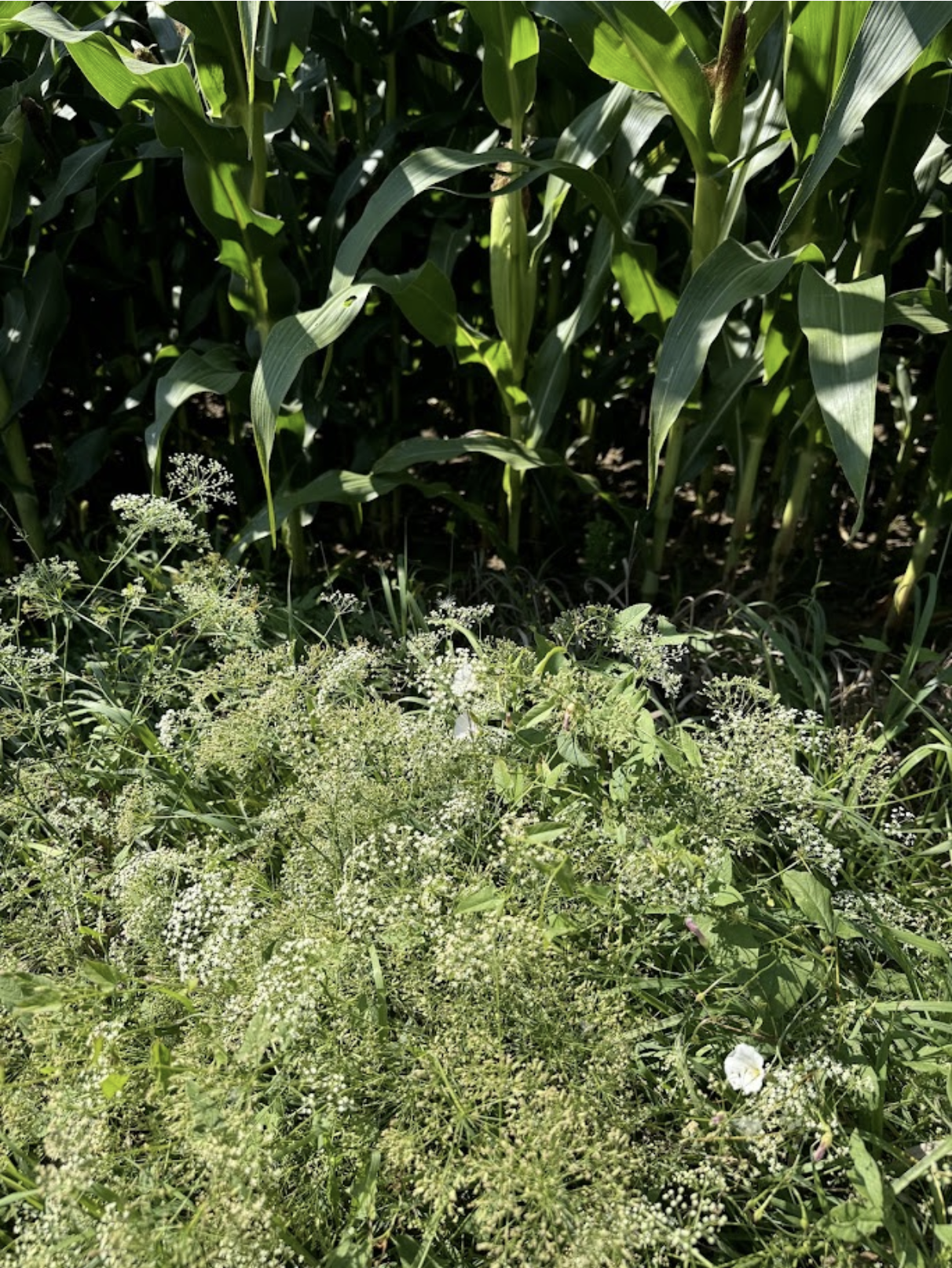
Sickleweed forms rounded umbels of white flowers that resemble other members of the wild carrot family, such as Queen Anne’s lace and poison hemlock. Photo: Susan Lehnhardt
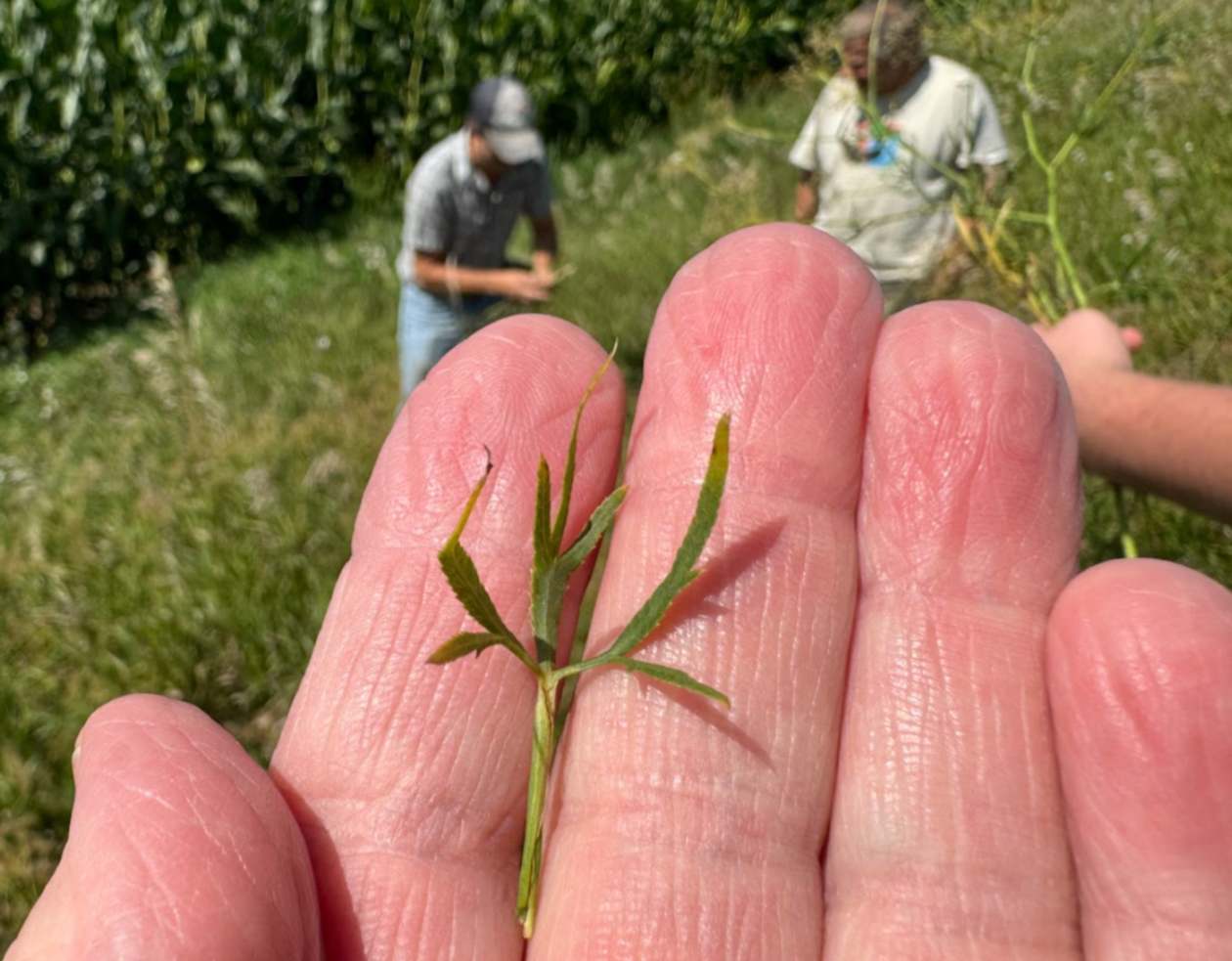
The diagnostic feature — simple, deeply lobed leaves with sharply toothed margins. Every look-alike in the Carrot Family has leaves that are 2–3 times compound without sharply toothed margins. Photo: Susan Lehnhardt.
Growth habit
A much-branched, rounded herb with ribbed, solid stems — unusual in the Carrot Family, most of which have hollow stems. Plants typically stand 1–2 feet tall in Wisconsin and can reach roughly 3 feet. Belowground, sickleweed produces a deep, fleshy taproot that can extend more than 20 inches, with dormant adventitious buds along most of its length.
Leaves — the key character
Leaves are alternate and simple, deeply pinnately lobed, with narrow, sickle-shaped lobes and sharply toothed, cartilaginous margins. Most basal leaves have withered by the time plants flower.
Flowers and fruit
Small white flowers with five petals, borne in compound umbels on branched stems, generally July through August in southern Wisconsin. The fruit is dry and smooth and splits into two one-seeded halves. During fall senescence, the stem naturally breaks at the nodes, and plant segments tumble in the wind — a second, independent dispersal mechanism.
Do not confuse it with its relatives
Sickleweed resembles other non-native, white-flowered members of the Carrot Family found along Wisconsin roadsides — Queen Anne’s lace (Daucus carota), wild chervil (Anthriscus sylvestris), and poison hemlock (Conium maculatum). The distinction is the leaf: sickleweed’s leaves are simple and deeply lobed with sharply toothed margins, while all three look-alikes have leaves that are 2–3 times compound. A detailed side-by-side identification fact sheet is available from the Renz Weed Science Lab (see Resources, below).
A note on toxicity. Unlike poison hemlock, sickleweed is not known to be acutely poisonous — it is used as a food plant in parts of its native range. That is not a license to handle it casually, and it is emphatically not a reason to taste any wild member of the Carrot Family: the family contains several of the most dangerous plants in North America, and misidentification has been fatal. Learn the plant; do not eat it.
Why it matters
Sickleweed is native to Europe, the Mediterranean, Asia Minor, and central Asia, and was first reported in the United States no later than 1922, with independent introductions on the East Coast and in the Midwest. It has since been recorded in roughly 15–16 states and more than three dozen counties. Nebraska’s Invasive Species Council lists it as a Category II invasive species.
The clearest warning comes from South Dakota. At the Fort Pierre National Grassland, sickleweed was first collected in 1992 in an area of roughly 160 acres described at the time as being in good condition with high species diversity. By 2005, the U.S. Forest Service estimated the infestation at approximately 3,200 hectares — nearly 8,000 acres. Research conducted there found:
It suppresses native grasses. In dense stands, total non-sickleweed plant biomass was 23 percent lower than in uninvaded plots, and native grass biomass was reduced by roughly 31–32 percent. Notably, clipping sickleweed for a full year did not relieve the suppression of native grasses, which suggests the interaction may be more than simple competition for light and water — possible allelopathy, as reported in other members of the Carrot Family.
It regenerates from root fragments. Four-centimeter segments cut from taproots produced new shoots 68–82 percent of the time, regardless of where on the root they were cut. Transplanted plants sent up new shoots as much as one meter away from the parent — spread by root sprouting, which explains the circular patches typical of early infestations.
Fire did not control it. A late-August prescribed burn on an invaded area produced no observed reduction in sickleweed abundance.
Mowing alone did not eliminate it. A population near a greenhouse on the South Dakota State University campus has persisted since the 1970s despite frequent mowing.
One important weakness. Sickleweed seed does not appear to build a long-lived seed bank. Published work indicates the seed persists in soil for less than one year, and germination trials show meaningful viability loss after 12 to 18 months of storage. Where sickleweed behaves as a biennial, a few consecutive years of cutting or grazing before seed set can exhaust a population. Where it behaves as a root-spreading perennial — as it does at Fort Pierre, and as its growth form at Monroe suggests may be possible here — cutting alone will not stop it.
What landowners, road crews, and agencies can do now
Fix the mowing calendar first. This is the single highest-value action in Green County. Cut road margins before seed ripens, not after. Mowing a seed-bearing stand shatters and windrows viable seed along the shoulder and is the most likely explanation for the linear spread observed at the Monroe site.
Clean equipment between sites. Remove plant material and seed from mowers, trimmers, decks, and tires before moving to the next stretch of road or the next field.
Do not till, disk, or blade through a patch. Root fragments as small as a few centimeters readily produce new shoots. Subsurface disturbance can multiply a colony rather than remove it.
Dig small patches carefully. Remove the full taproot where the infestation is small enough to hand-dig, and bag the material rather than composting it on site.
Use herbicides where they are warranted, and use the right ones. Most herbicides tested against sickleweed have been largely ineffective. The exceptions documented in South Dakota trials are the sulfonylureas chlorsulfuron (Telar XP) and metsulfuron-methyl (Escort XP), applied in spring; two successive annual applications reduced plot frequency from 68 to 14 percent, foliar cover from 19 to 1 percent, and density from 645 to 24 stems per square meter. Picloram (Tordon) provided 90–99 percent control in earlier trials. These products carry significant site, crop-rotation, and rights-of-way restrictions. Consult UW–Madison Extension or your county land conservation department before treating, and always follow the label.
Expect the response to be slow. With ALS-inhibiting herbicides, yellowing appears within one to four weeks, but full effects are often not apparent until the following spring. Plan on multiple consecutive seasons.
Report what you find. Log locations on EDDMapS, notify your county Land and Water Conservation Department, and contact the Wisconsin First Detector Network or the Renz Weed Science Lab. Early detection and rapid response are far cheaper and far more effective than treating a mature infestation years later.
Regulatory status in Wisconsin
Sickleweed is not currently regulated under Wisconsin Administrative Code Chapter NR 40, the state’s invasive species rule. That may change. The Wisconsin Department of Natural Resources is revising NR 40 — the public comment period closed August 7, 2026 — and has indicated interest in the Green County population as it considers whether to add Falcaria vulgaris to the prohibited category. DNR staff have asked to visit the site during flowering.
Landowners should note that a species need not be listed to be worth controlling. The species most likely to be eradicable are precisely those that have not yet spread far enough to be regulated.
"The encouraging part of this story is how much a single pair of eyes accomplished," Apfelbaum said. "A plant nobody in the room recognized went from a roadside specimen to a herbarium voucher to a state agency rulemaking conversation in under two years — because a farmer, a student, a watershed ecologist, county staff, and a university lab all picked up the thread. That is what early detection actually looks like. The first and most important step is simply learning to see it."
Identification resource
The Renz Weed Science Lab at UW–Madison has produced a dedicated sickleweed identification fact sheet covering growth habit, leaf and flower characters, look-alike species, and known Wisconsin distribution. It is the recommended field reference for anyone learning this plant:
Renz Weed Science Lab. Sickleweed (Falcaria vulgaris). Department of Plant and Agroecosystem Sciences, College of Agricultural and Life Sciences, University of Wisconsin–Madison. Available at: https://renzweedscience.cals.wisc.edu/wp-content/uploads/sites/177/2025/01/Falcaria-vulgaris.pdf
Discovery, ecological context, and land stewardship
Steven Apfelbaum, Senior Ecologist and pilot
Applied Ecological Institute, Brodhead, Wisconsin
Email: steve@aeinstitute.org • Phone: (608)-201-9375
Field monitoring, specimens, and local coordination
Susan M. Lehnhardt, Ecologist
Lower Sugar River Watershed Association
Lower Sugar River Field Station at Three Waters Reserve
3941 Golf Course Road, Brodhead, WI 53520
Email: lehnhardt.susanm@gmail.com • Cell: (608) 558-5941